
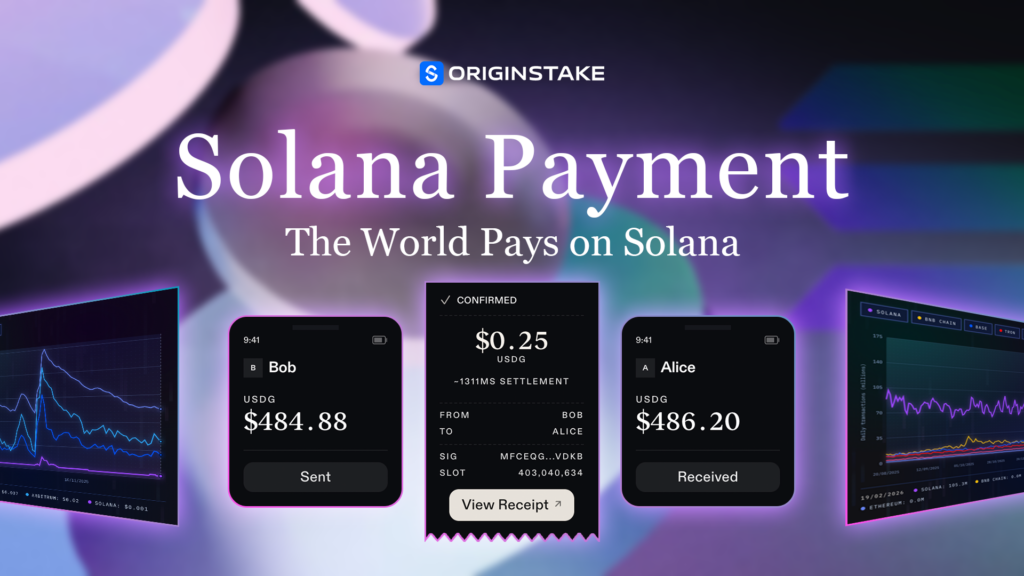
Imagine sending $500 to your family in the Philippines — and it arrives in half a second, for less than a penny. No bank intermediary, no 3-day waiting window, no $30 wire fee. That’s not a vision of the future. That’s Solana Payment, running live in production today.
Solana has quietly become the world’s most-used crypto network for payments. With $2 trillion in quarterly stablecoin transfers, 143 million daily transactions, and a 755% volume growth rate, Solana isn’t just competing with traditional finance — it’s rewriting the rules.
In this article, we break down what makes Solana the leading blockchain for payments, who’s building on it, and why enterprises from Western Union to Goldman Sachs have chosen it over every alternative.
What Is Solana Payment?
Solana Payment refers to the use of the Solana blockchain as the underlying infrastructure for processing financial transactions — from cross-border remittances and payroll to merchant checkout and corporate treasury management.
Unlike traditional payment rails that were built decades ago, Solana was engineered from the ground up for speed, scale, and cost efficiency. The network went live in 2020 and has since processed more transactions than all other blockchains combined.
Performance That Leaves Every Competitor Behind
Numbers don’t lie. Here’s how Solana stacks up against the biggest names in payments:
- Solana: 2,400+ TPS real | ATH 100,000 TPS | Median fee $0.0013 | Settlement ~500ms
- Visa: 1,700 TPS | ATH 65,000 TPS | Fee 2.40% + $0.10 | Settlement 1–3 days
- SWIFT: 520 TPS | Fee $35–$100 | Settlement 1–5 days
- Ethereum: 29 TPS | Median fee $0.80 | Settlement ~3 minutes
- Base: 166 TPS | Median fee $0.0038 | Settlement 3–9 minutes
On October 10, 2025, while Ethereum fees spiked to over $100 per transaction and Base to tens of dollars, Solana users continued paying under $0.001. That’s the power of Solana’s local fee markets — predictably low costs, even under peak load.
Who Is Using Solana for Payments?
Solana payment adoption isn’t limited to crypto-native startups. Some of the world’s most recognizable financial institutions are actively building and deploying on Solana:
- Western Union – Launched USDPT, a stablecoin for cross-border remittances on Solana.
- PayPal – Built PYUSD stablecoin using Solana’s Token Extensions for compliance.
- Goldman Sachs – Disclosed $108M in SOL holdings.
- BlackRock – BUIDL tokenized fund surpassed $550M in assets on Solana.
- Citigroup – Executed a tokenized Bill of Exchange natively on Solana.
- Fiserv & R3 – Chose Solana’s compliance-friendly stack for financial infrastructure.
- Gusto – Enables same-day payouts in any country via USDC on Solana.
- WisdomTree – Expanded tokenized fund access to Solana.
Meanwhile, Phantom — Solana’s flagship wallet — has 16 million funded accounts, surpassing publicly traded fintechs like SoFi (12.6M), Wise (13.4M), and Remitly (9.1M).
Key Use Cases for Solana Payments
1. Cross-Border Remittances
Traditional remittances cost senders an average of 6–7% in fees. Solana eliminates most of this cost by bypassing correspondent banking networks entirely. Transactions settle in seconds, 7 days a week — including holidays. Companies like Zepz are already using Solana to offer near-free global money transfers.
2. Payouts at Scale
Whether you’re paying 10 freelancers or 10 million users, Solana handles it without flinching. Gusto uses Solana and USDC to enable same-day payouts across international borders — something the traditional banking system simply cannot match.
3. Stablecoin Infrastructure
Solana hosts all of the world’s top 10 stablecoins. With over $2 trillion in quarterly stablecoin volume, it is the stablecoin chain of choice. Businesses can convert between stablecoins or off-ramp to fiat with minimal slippage, backed by deep, native liquidity.
4. Card Issuance & Merchant Payments
Fintech companies and neobanks are issuing Solana-backed debit and credit cards. At the point of sale, settlement happens in under a second — no chargebacks, no holds, no overnight batch processing.
5. Agentic & AI Payments
As AI agents become more autonomous, they need payment rails that operate at machine speed. Solana’s programmability and sub-second finality make it the ideal layer for agentic finance — from automated treasury management to AI-driven trading and micro-transactions.
Enterprise-Grade Privacy & Compliance
One of the biggest barriers for financial institutions entering blockchain has always been regulatory compliance. Solana addresses this head-on with a modular, three-layer privacy stack:
- Token Level – Issue permissioned assets with KYC allowlists, blocklists, freeze/seize controls, and confidential transfers using zero-knowledge proofs. Designed to comply with regulations like the GENIUS Act.
- Validator Level – Use trusted, private infrastructure while maintaining access to Solana Mainnet’s deep liquidity.
- Network Level – Configure private execution environments with full compliance controls at the network layer.
This is why PayPal, Western Union, Fiserv, and R3 all chose Solana over other chains — it delivers public liquidity with private, compliant execution.
Solana Is the Fastest-Growing Payments Platform on the Planet
Total Payments Volume Growth Rate comparison tells the full story:
- Solana: +755%
- BNB Chain: +648%
- Ethereum: +625%
- Adyen: +43%
- Block Inc: +8%
- PayPal: +6%
No other payments platform — crypto or traditional — comes close to Solana’s growth trajectory. This isn’t speculative. It’s live, verifiable, on-chain data.
A Developer Ecosystem Built for Payments
Solana’s payments ecosystem gives developers everything they need to build production-grade applications:
- Token Extensions – Compliance-ready token standard with confidential transfers, memos, and permissioning.
- Contra – A new enterprise payment stack from the Solana Foundation.
- Payments Docs – Comprehensive developer documentation at solana.com/docs/payments.
- Modular Infrastructure – Plug-and-play integrations with every major exchange, custodian, on-ramp, and wallet.
The breadth of the ecosystem means developers are never locked into a single provider. From Backpack to Phantom, from Circle to Jupiter — everything interoperates seamlessly.
Conclusion: Solana Payment Is Not the Future — It’s Now
The payments industry is at an inflection point. SWIFT was built in 1973. Visa’s core infrastructure dates back to the 1970s. Neither was designed for a world of instant, global, programmable money.
Solana was. With 2,400+ TPS, $0.001 fees, 500ms settlement, enterprise compliance tools, and $2 trillion in quarterly stablecoin volume, it has already earned the trust of the world’s largest financial institutions — and the fastest-growing developer community in crypto.
Whether you’re a startup building the next neobank, a corporation exploring stablecoin treasury, or an enterprise looking to modernize cross-border payments — Solana is where you build.
Explore Solana Payments today at payments.org
FAQ – Solana Payment
What is Solana used for in payments?
Solana is used as a high-performance blockchain infrastructure for cross-border remittances, stablecoin transfers, payroll payouts, merchant payments, card issuance, and institutional settlement. It processes over 143 million transactions per day with sub-second finality.
How fast is Solana for payments?
Solana settles transactions in approximately 500 milliseconds (0.5 seconds), with a peak capacity of 100,000 TPS and a sustained real-world throughput of over 2,400 TPS — faster than Visa’s average of 1,700 TPS.
How much does a Solana payment transaction cost?
The median transaction fee on Solana is approximately $0.0013 — a fraction of a penny. This remains stable even during high-traffic periods, thanks to Solana’s local fee market architecture.
Is Solana compliant for financial institutions?
Yes. Solana offers a three-layer compliance stack: Token Extensions (confidential transfers, KYC controls, freeze/seize), validator-level private execution, and network-level permissioning. PayPal, Fiserv, Western Union, and R3 have all built on Solana for this reason.
What stablecoins does Solana support?
Solana supports all of the world’s top 10 stablecoins, including USDC, USDT, PYUSD (PayPal), and USDG. It processes over $2 trillion in stablecoin transfers per quarter, making it the leading stablecoin chain by volume.