
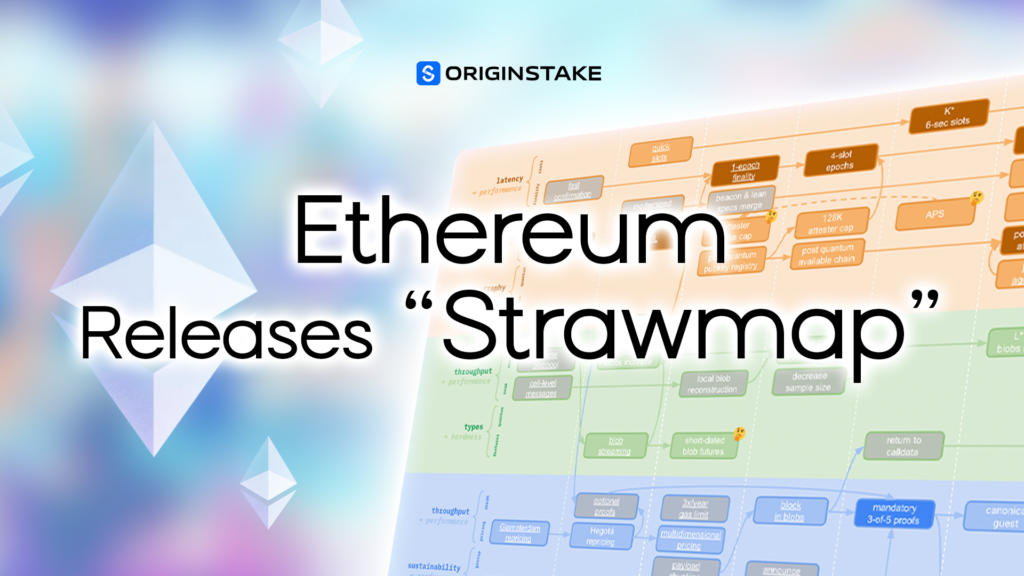
Ethereum Foundation’s (EF) newly released “Strawmap“—a comprehensive, decade-long strategic roadmap designed to elevate Ethereum’s Layer 1 (L1) capabilities while strengthening privacy features and preparing the network for future quantum threats.
What is the “Strawmap”?
The “Strawmap” (a deliberate “strawman” proposal to spark discussion in Ethereum’s decentralized ecosystem) outlines an ambitious plan spanning multiple protocol upgrades through 2029. Developed by EF Protocol researchers and introduced as a visual big-picture guide, it targets five core “north stars”:
- Near-instant finality and significantly faster block times (potentially reducing from 12 seconds to as low as 2 seconds through incremental steps).
- Higher throughput — aiming for up to 10,000 transactions per second (TPS) on L1 and 10 million TPS on Layer 2 (L2) solutions.
- Built-in privacy mechanisms, allowing users to shield balances and transaction histories without relying solely on external tools.
- Post-quantum security to protect against future quantum computing attacks.
- Scalable and seamless L2 integration for an improved overall user experience.
These advancements will leverage cutting-edge technologies such as zkEVMs (zero-knowledge Ethereum Virtual Machines), data availability sampling, erasure-coded P2P networking, and hash-based or STARK-friendly cryptography for quantum resistance. The roadmap envisions roughly seven protocol forks (upgrades) by the end of 2029, delivered at an approximate cadence of one every six months.
Ethereum co-founder Vitalik Buterin has described the document as “very important,” providing detailed commentary on achieving “fast L1” goals safely while maintaining decentralization and security.
Why Quantum Resistance Matters Now
With quantum computing advancing rapidly, concerns about its potential to break current cryptographic schemes (such as ECDSA signatures and BLS consensus signatures) are growing. Vitalik Buterin has separately outlined a “quantum roadmap” to phase in post-quantum upgrades across vulnerable protocol components. The Strawmap integrates these efforts, positioning Ethereum to remain secure even if quantum threats materialize in the coming years (some estimates suggest risks as early as the late 2020s).
This proactive stance aligns with similar discussions in other networks, but Ethereum’s focus on native, built-in protections sets a strong foundation for long-term resilience.
Market Context and Implications for Stakers
The announcement comes amid a strong market recovery. As of February 27, 2026, ETH is trading around $2,100+, reflecting recent gains driven by broader crypto momentum and institutional interest. Vitalik Buterin’s periodic ETH sales (recently in the range of thousands of ETH to fund development) continue as a transparent way to support the ecosystem without external debt—though some view them skeptically.
At OriginStake, we see the Strawmap as a major long-term catalyst for Ethereum’s value and utility. Enhanced scalability means lower fees and faster confirmations, directly benefiting staking rewards and network participation. Built-in privacy and quantum readiness will attract more institutional and privacy-conscious users, driving adoption and ETH demand.
Whether you’re already staking ETH or exploring opportunities in the ecosystem, these upgrades reinforce Ethereum’s position as the leading smart contract platform. Stay tuned to OriginStake for in-depth analysis, staking guides, and updates on how these developments impact your portfolio.
Ethereum is evolving—secure, scalable, and future-proof. The future looks bright for stakers and the entire community!
—

Validator • Infrastructure • RPC • Decentralization
Not financial advice. Educational content only.