Rollups are evolving – and Celestia is at the center of that transformation. As demand for scalable and sovereign blockchain solutions increases, rollups are moving away from general-purpose platforms like Ethereum toward modular, dedicated infrastructure.
Celestia offers this shift by decoupling execution from consensus and data availability, giving rise to a new paradigm: sovereign rollups. In this article, we explore how Celestia empowers the next generation of rollups and why its modular architecture is redefining blockchain scalability.
The Modular Blockchain Vision
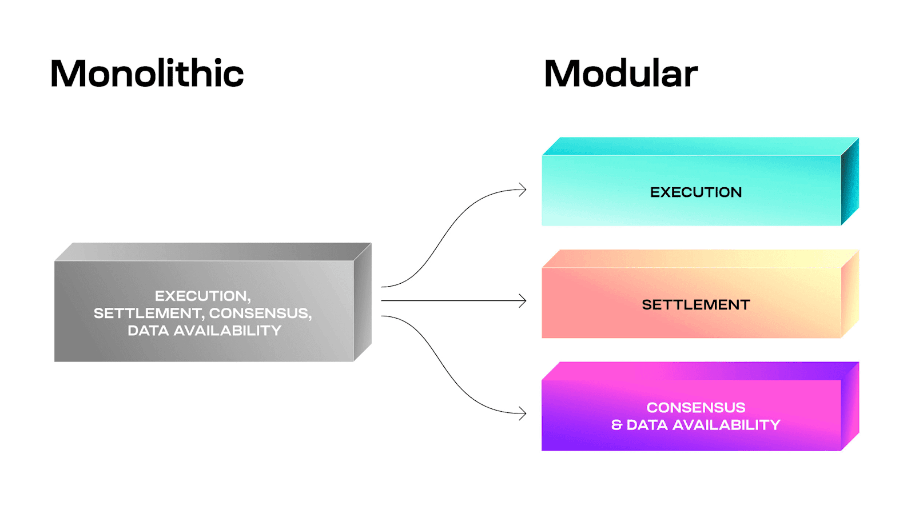
Traditional blockchains operate as monolithic systems, bundling execution, settlement, consensus, and data availability into a single layer. While this design simplifies coordination, it severely limits scalability. As usage increases, every node must process and store every transaction – leading to congestion, high fees, and centralization pressures.
Celestia introduces a modular architecture that breaks this paradigm. It focuses solely on consensus and data availability (DA), leaving execution and settlement to external layers such as rollups. This separation enables horizontal scalability: instead of stacking complexity on one chain, developers can deploy thousands of chains in parallel, each optimized for their own needs.
Sovereign Rollups: Independence at Scale
Rollups are not new, but most existing rollups are still tightly coupled with Ethereum. They rely on Ethereum for security, censorship resistance, and DA, and must conform to Ethereum’s execution model. This creates a tradeoff between scalability and sovereignty.
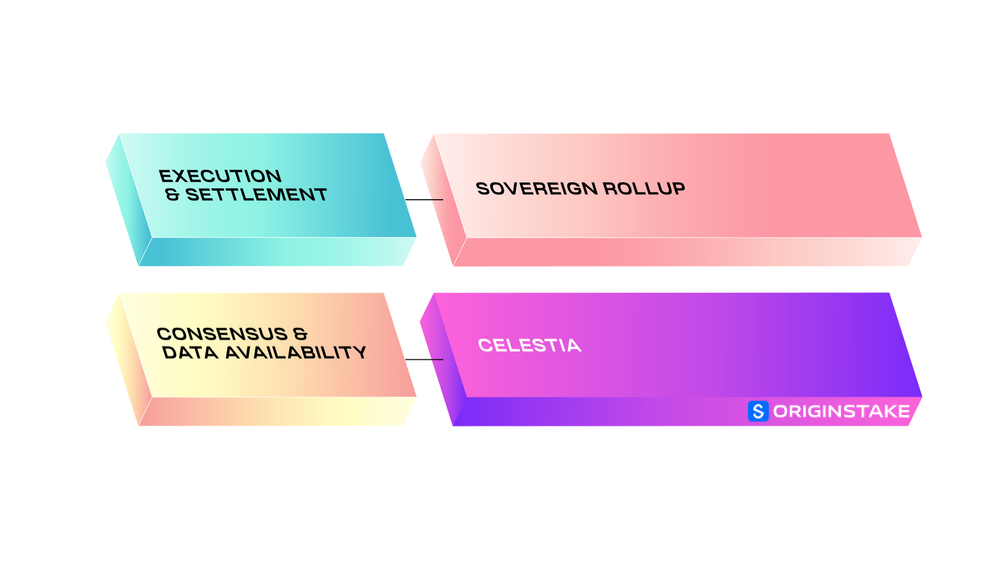
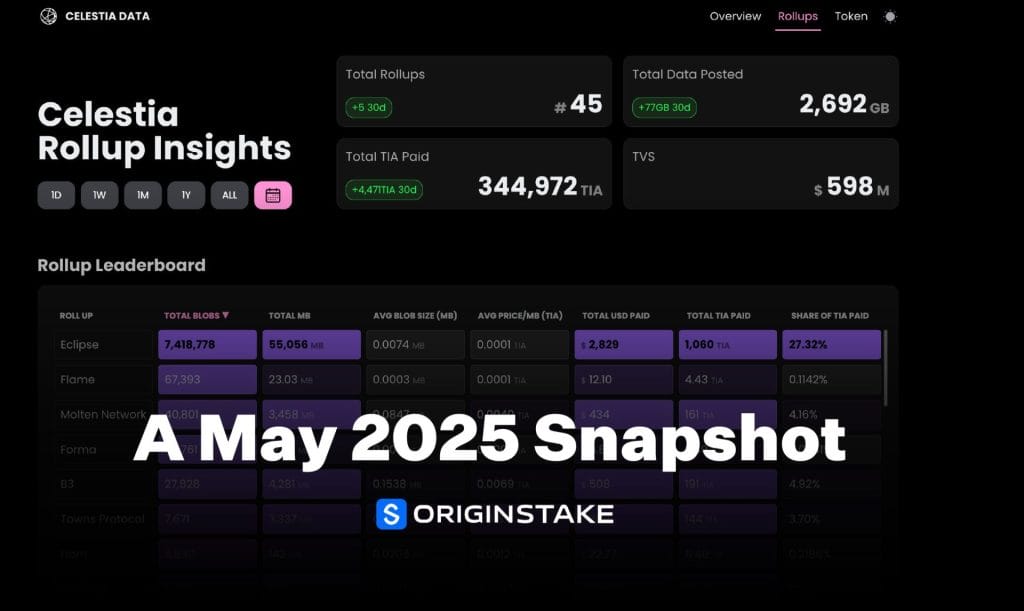
Celestia eliminates that tradeoff by enabling sovereign rollups: blockchains that write their data to Celestia for DA and consensus but handle execution, governance, and upgrades independently. These rollups don’t need to depend on smart contracts deployed on another chain or conform to external upgrade paths. You can take a look at an overview of Celestia’s rollups ecosystem on May, 2025 at our article “Celestia’s Thriving Rollup Ecosystem: A May 2025 Snapshot“
How Celestia Scales: Data Availability Sampling
At the core of Celestia’s scaling model is Data Availability Sampling (DAS). Traditional full nodes verify blocks by downloading all transaction data, but DAS allows light nodes to sample small portions of a block and still verify whether data is available. This is enabled through 2D Reed-Solomon erasure coding, which guarantees that any small random sample can probabilistically confirm full data availability.
DAS allows Celestia to scale with demand. As more light nodes join, the network can support larger block sizes – potentially up to gigabytes – without sacrificing decentralization. Unlike monolithic chains, which become more burdensome as they grow, Celestia grows more scalable as its node ecosystem expands.
Real Adoption: Rollups Choose Celestia
Celestia is already powering a growing ecosystem of rollups. Projects such as Dymension, Eclipse, and Cevmos are choosing Celestia for its low-cost blobspace and flexibility in execution environments. These rollups are building:
- Ethereum-compatible chains
- Cosmos SDK-based rollups
- Custom VMs – all anchored to Celestia’s DA layer
What’s compelling is that these rollups do not need permission from Celestia to launch:
- No reliance on smart contracts or permissioned sequencers
- Rollups publish block data directly to Celestia’s DA layer
- Each chain operates independently, with its own governance and upgrade path
This decentralized approach has led to a rapid increase in deployments on Celestia’s Mocha and Arabica testnets, with dozens of rollups actively experimenting with the architecture. As adoption grows, Celestia’s role as the default DA layer for modular chains is becoming increasingly evident.
Lower Costs, Greater Flexibility
Ethereum rollups currently suffer from high calldata costs due to Ethereum’s limited DA capacity. Celestia’s architecture offers a more cost-efficient alternative. Blobspace on Celestia is priced separately from execution, allowing rollups to pay only for what they store – without subsidizing global computation.
In addition, Celestia’s namespaced Merkle trees (NMTs) allow each rollup to retrieve and verify only the data relevant to them. This structure enhances scalability and composability, enabling multiple rollups to share the same DA layer while maintaining data isolation and integrity.
A Foundation for the Modular Future
Celestia is not a rollup platform, it is a rollup enabler. By focusing on data availability and consensus, it provides the foundation for a future where thousands of application-specific chains can coexist, interoperate, and scale without friction. This modular design is not just an optimization – it’s a fundamental rethink of how blockchain networks can grow and specialize.
With tools like Blobstream, Rollkit, and Hyperlane bridging the modular stack, Celestia is laying the groundwork for a Web3 ecosystem that is more decentralized, more scalable, and more composable than ever before.
Conclusion
Celestia is ushering in a new era for rollups – one defined by sovereignty, scalability, and simplicity. By unbundling consensus and data availability from execution, it opens up design space for developers to innovate freely, without the constraints of legacy monolithic chains. Whether you’re building DeFi, games, social protocols, or AI-integrated apps, Celestia provides the trust-minimized infrastructure to scale with confidence.
As the modular thesis gains traction, Celestia is proving to be a foundational layer for the next generation of blockchain infrastructure – where rollups don’t just scale the past, but unlock the future.

Are you ready to join the Celestia ecosystem? Follow Celestia to stay updated with the latest news and explore staking opportunities with OriginStake to maximize your profits!